
To verify online class service legitimacy in 2026, you must check for transparent pricing, verifiable student reviews on third-party forums, and a functional refund policy that doesn’t lock your money in a “virtual wallet.”
The demand for reliable online class services is sky high. And when the demand is high, the market is flooded with providers. But practising caution is extremely important, as recent consumer reports indicate a sharp rise in “service-based” fraud: websites collect tuition fees and then vanish, or, worse, deliver AI-generated work that triggers academic flags. It is not just about losing $50; it is about risking your enrollment.
However, thousands of students still successfully manage their course loads by knowing exactly which providers to trust. This guide acts as your independent screener to help you check if online class service is legit or a scam.
Recommended Online Class Help Websites (2026 Review)
| Website Name | Best For | Why It’s Recommended | Risk Level |
| Assignments4u | Essay & Written Assignments | Strong plagiarism controls, consistent deadlines, real academic formatting | Low |
| BoostMyGrade | Students Who Want Control | Direct expert communication, clear refund policy, transparent workflow | Low |
| BuyOnlineClass | Budget-Conscious Students | No hidden fees, flexible payment options, clear invoicing | Low |
| GoTakeMyOnlineClass | STEM & Technical Courses | Experts familiar with Canvas, Pearson, and Cengage interfaces | Low |
| DomyOnlineClass123 | Financial Security Seekers | 50% upfront / 50% after completion model with grade accountability | Low |
Legitimate Service vs. A Scam: Key Red Flags

Before you hand over your login credentials, you need to conduct a quick background check and a comparative Online Class Help Review.
Always remember, legitimate businesses want to solve your academic stress; scams generally want to hold it hostage. You can often determine the validity of a site within the first minute by looking for specific markers.
Here are the core red flags to watch:
Hidden “Software Fees”
Be wary of services that quote a low Online Class Help Cost initially but later demand extra payments for “VPN encryption” or “gateways.” This is a classic bait-and-switch tactic.
Zero-Day Domains
If a website claims “10 Years of Excellence” but the domain was registered last month, proceed with extreme caution. Scams often burn through domains quickly to escape bad reviews.
Missing Expert Profiles
Transparency is crucial in academia. If a site completely hides its team and offers no information about their tutors’ qualifications, specialized subjects, or credentials, it is a significant risk. You have no way of knowing if your “PhD Expert” is actually a qualified professional or simply a gig worker using AI tools.
Proof of Work Missing
Trust is built on evidence, not promises. Best Online Class Help Service providers like Assignments4u, BuyOnlineClass, and DoMyOnlineClass123 proudly share portal screenshots of their work, demonstrating how they have achieved promising grades for other students. If a site relies solely on stock photos of smiling graduates without showing real portal results, avoid it.
Demanding Upfront Payment (Without Recourse)
Be skeptical of experts who demand 100% upfront payment via non-refundable methods like Crypto or Zelle. Safer options usually offer milestone payments (50% start / 50% finish) or secure card processing.
No Refund Policy
Check the footer links for safe take my class services. If the refund policy is missing, vague, or non-existent, the service is essentially telling you that they plan to keep your money even if they fail the class.
No Direct Communication with Expert
The “Middleman” trap is dangerous. If a service blocks you from speaking directly with your tutor to clarify assignment details, it is often because the “expert” lacks the language fluency or qualifications to communicate with you effectively.
3 Steps to Verify Online Class Service Legitimacy
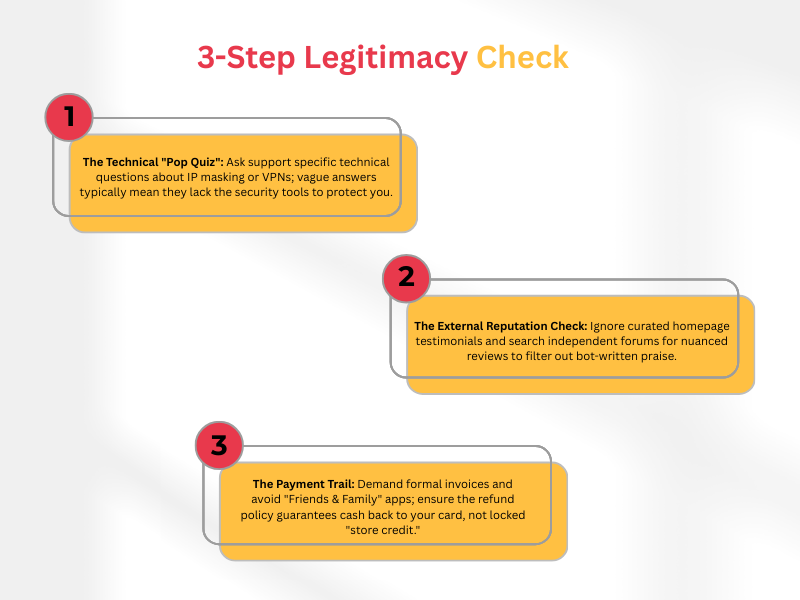
Don’t guess, verify. As independent reviewers, we recommend this specific protocol. Use this online class service scam check before you commit:
1. The “Specific Question” Test
Engage their live chat support. Instead of asking “Can you take my class?”, ask a technical question like, “Do your experts use a local IP VPN for Canvas logins to match my location?”
- Safe Response: They explain their security protocol regarding IP masking.
- Risky Response: They give a vague “Yes, we do good work” answer or ignore the technical aspect entirely.
2. The Reputation Cross-Reference
Ignore the online class help service reviews on their homepage—they are curated. Instead, search independent threads. Look for nuanced feedback.
For instance, looking at the operational differences in TakeMyClassOnline.net vs BoostMyGrade quickly highlights the gap between a site frequently flagged for communication silence and one that offers a verified user portal.
Legitimate services will have a mix of reviews, whereas scam sites often feature generic, bot-written praise. Specifically, look for confirmation that they handle revisions willingly.
3. The Invoice and Refund Clarity
Legitimate services provide clear invoices detailing exactly what you are paying for. Be wary of requests for payments via “Friends and Family” methods on cash apps, which offer no recourse. Furthermore, verify the refund policy: ensure that if they fail, the money goes back to your card, not a “store credit” wallet.
Proven Solutions: Matching Your Academic Crisis to the Right Service
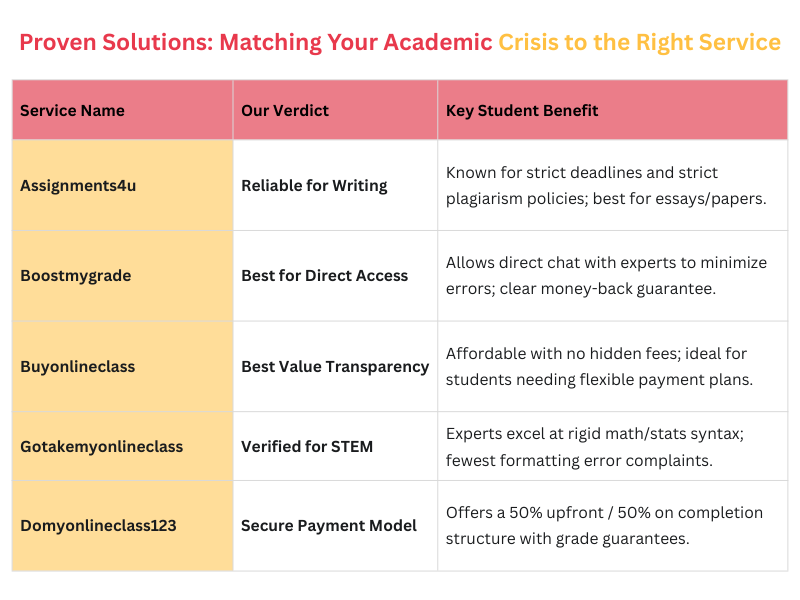
Different students have different requirements. A service that is perfect for writing an English paper might fail miserably at a Calculus test. We analyzed hundreds of user submissions to determine which platforms performed best for specific student situations.
Situation 1: “I Need Consistent, High-Quality Written Papers”
When the primary concern is plagiarism and flow, consistency is king. Students who prioritized professionalism in their reviews consistently pointed to Assignments4u as a safe harbor.
The feedback suggests that, unlike freelance marketplaces, their internal team adheres strictly to deadlines and formatting rules. We found that users rarely complained about plagiarism flags here, making it a solid choice if your coursework is essay-heavy and requires a polished academic tone.
Situation 2: “I Want Direct Control and Communication”
A major anxiety for students is the “silent treatment,” where instructions get lost in translation. If you are the type of student who needs to oversee the process, reviews indicate that BoostMyGrade offers a distinct advantage.
Users highlight the ability to chat directly with their assigned tutor rather than a support bot. This transparency seems to drastically reduce errors in complex assignments, justifying the premium for many users who want to feel “in the loop.”
Situation 3: “My STEM Course Has Strict Formatting Rules”
Math and Statistics platforms like Pearson or Cengage are unforgiving; a correct answer in the wrong format is marked zero. For this unique struggle, Gotakemyonlineclass and BuOnlineClass garnered overwhelmingly positive feedback.
Verified users suggest their experts are not just good at math, but fluent in the specific software interfaces. We noted significantly fewer complaints about “syntax errors” or “formatting deductions” compared to generalist sites.
Situation 4: “I Need Financial Security and Guarantees”
Trust issues are natural when paying a stranger online. If your priority is financial safety, Domyonlineclass123 stood out in our analysis for its risk-averse payment structure.
Students appreciated the ability to pay 50% upfront and the rest upon completion. Coupled with verifiable portal screenshots of previous work, this model seems to provide the peace of mind that cautious students are looking for.
Critical Warnings: Where Students Frequently Reported Failures
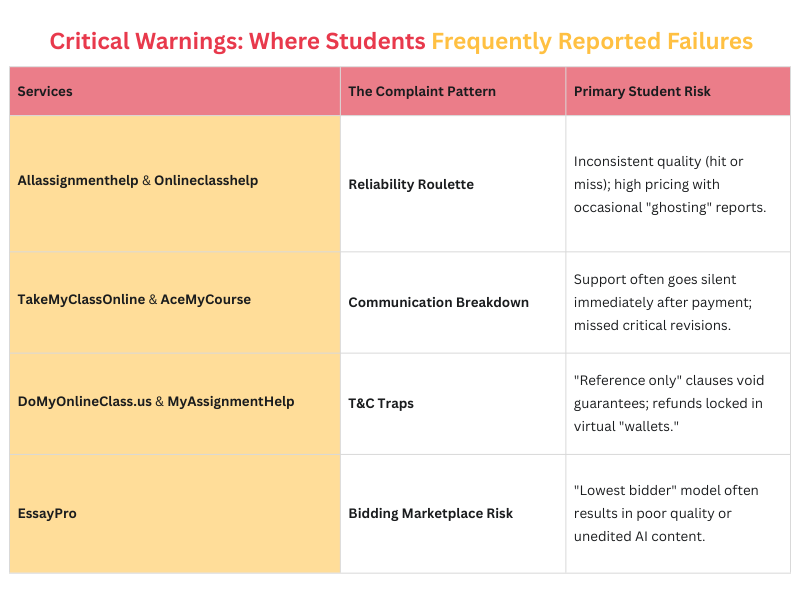
Conversely, our analysis of complaint logs reveals specific patterns of failure. By reading through negative user experiences, we identified the common traps you need to avoid to save your grade and your money.
Trap 1: The “Inconsistency” Gamble
Nothing is more frustrating than receiving an ‘A’ one week and a ‘D’ the next. This “reliability roulette” is a frequent complaint for users of massive aggregators like Allassignmenthelp and Onlineclasshelp.
While they market heavily, verified reviews suggest that quality varies wildly depending on which random freelancer picks up your ticket. Specifically regarding Onlineclasshelp, we noted reports of high pricing that simply did not match the sporadic support quality, with some users feeling ghosted after payment.
Trap 2: The “Post-Payment Silence” Panic
For deadline-driven students, silence is terrifying. A recurring theme in complaints for TakeMyClassOnline and AceMyCourse is the communication blackout. Students described the panic of paying for a service and then waiting days for a response, often right before a deadline. If your situation is urgent, relying on services with a track record of unresponsive support during critical revision windows is a risk our data suggests you avoid.
Trap 3: The “Refund Loop” and Legal Loopholes
Perhaps the most damaging situations involve deception in the terms of service. We urge you to read the fine print to avoid the experience of students who used DoMyOnlineClass.us, only to find disclaimers stating the work was for “reference only,” invalidating any grade guarantees.
Similarly, be wary of the “Wallet Trap” reported by users of MyAssignmentHelp. Instead of refunding money to a bank account, reports indicate funds are often locked as store credit, forcing you to spend more on the very platform that failed you.
Trap 4: The “Bidding Marketplace” Risk
Finally, be cautious of the freelance auction model used by sites like EssayPro. While it can be cheap, it creates a “quality lottery.” Students have reported that in a race to the bottom on price, low-bidding writers often resort to using unedited AI content to speed up production. If you are looking to avoid academic integrity flags, trusting the lowest bidder is rarely a safe strategy. Further, you must know how to hire a class taker without getting caught to avoid academic integrity issues.
Conclusion
Outsourcing isn’t a gamble if you verify the provider. In 2026, distinguishing between a reliable grade-saver and a scam comes down to transparency. Avoid vague “wallet” refunds and hidden fees by choosing established names like Assignments4u or BoostMyGrade. Use our three-step scam check, demand clear invoices, and prioritize direct communication. Your academic future is an investment; protect it by choosing accountability over empty promises.
Leave feedback about this