

In the USA, GPA serves as the main numeric indicator of a student’s academic performance throughout the educational journey. Employers in the USA will look at your GPA when you apply for an internship or beginner-level jobs. They use it to understand how hard you work and how responsible you are with your studies. A good GPA tells them you are disciplined, focused, and able to handle tasks well.
However, students don’t know GPA meaning or how it changes in different stages of their education. This confusion becomes a big problem during major transitions, especially from high school to college. Research shows that when students start college, their GPA often drops by around 0.66 points, which surprises and discourages many of them. In this blog, we will cover what does GPA mean? How to calculate your GPA? We will also discuss how to improve your GPA.
What Is GPA?
GPA Meaning Explained
Looking for the GPA definition? Then let us explain. GAP means Grade Point Average. It is a number that shows how well you are doing in school. In the USA, it usually goes from 0.0. To 4.0. Each grade you get, like A, B, C, or F, has a numerical value (A=4, B=3, C=2, and so on).
Also, each course has credit hours. After adding all your grade points, divide the total credits to get your GPA. It’s basically your overall score for all your classes.
How Is GPA Calculated?
In this section, we will discuss the GPA calculation method as we have discussed above, A=4, B=3 and so on. To find your GPA, these numbers are added up and then divided by the number of classes you took. Sometimes, classes with more credits count more in the calculation.
For example, if you get a C in all of your courses, then your GPA will be around 2.0. On the other hand, if you mostly got C grades but a B in a few subjects, your GPA might go slightly higher, like 2.1.
A higher GPA shows that you’re performing better in academics, whereas a lower GPA shows that you have plenty of room to improve and reach the Average GPA that many colleges look for.
Understanding the Various Types of GPA
Looking for how GPA works? Then go through this section, as here we will discuss a few different kinds of GPA, and each one shows your academic performance in a slightly different manner:
Cumulative GPA
Want to know what does cumulative GPA mean? Then this is your overall GPA. This type includes every class you’ve taken since you started school or college. Furthermore, it gives a broad picture of your long-term academic performance.
Semester (Term) GPA
This GPA covers only one semester or term and helps you to see how well you performed during that specific period. Lastly, it also helps to track performance.
Weighted vs. Unweighted GPA
- Unweighted GPA:
The unweighted GPA is a calculation of your average grade, typically on a 4.0. Scale. Here, each letter grade has a standard point value regardless of the difficulty of the course.
- Weighted GPA:
Do you want to know what does weighted GPA means? Well, it calculates your average grade while giving more points for challenging courses. These courses can give you extra points, so your GPA can be higher than 4.0. It shows not just your grades but also the difficulty level of your courses.
Major GPA
This GPA only includes the courses related to your major or field of study. It shows how well you’re doing in the subjects that matter most for your chosen career or program.
GPA Meaning in the USA
Looking for the Grade Point Average meaning (GPA)? Well, in the USA, students are graded on a scale of 0.0 to 4.0. The number 0.0 is considered a failure grade, whereas 4.0 is the best score. Colleges in the USA quickly review your GPA to gauge your potential.
But GPA is not the only thing colleges care about. They also look at:
- Your extracurricular activities (sports, clubs, volunteering, etc.)
- Letters of recommendation from teachers
- Your SAT or ACT test scores
College admissions in the US can be competitive, but with effort, consistency, and confidence, you can reach your academic goals and get into the college you want.
GPA Conversion Chart in the USA
| Letter Grade | Percentage Range | GPA Equivalent |
|---|---|---|
| A+ | 97-100% | 4.0 |
| A | 93-96% | 3.75 - 3.89 |
| A- | 90-92% | 3.50 - 3.74 |
| B+ | 87-89% | 3.25 - 3.49 |
| B | 83-86% | 3.00 - 3.24 |
| B- | 80-82% | 2.75 - 2.99 |
| C+ | 77-79% | 2.50 - 2.74 |
| C | 73-76% | 2.25 - 2.49 |
| C- | 70-72% | 2.00 - 2.24 |
| D+ | 67-69% | 1.75 - 1.99 |
| F | Below 65% | 0.0 |
Top 4 Reasons Why GPA Is Important? (Uses and Benefits)
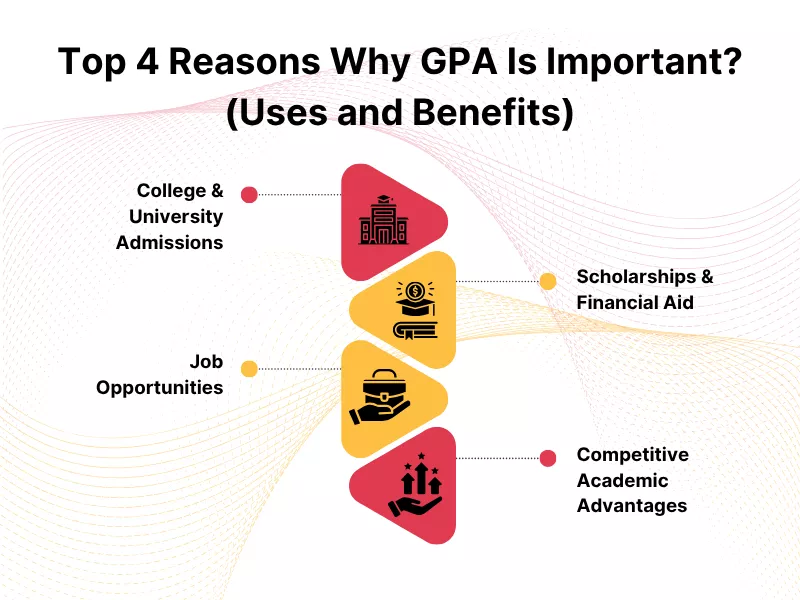
From the Best Online Class Help Service expert’s point of view, we will discuss here the importance of GPA in your academic career:
College & University Admissions
Colleges will look at your GPA to understand how well you’ve done in school. A good GPA highlights that you are ready for tougher college-level work.
Scholarships & Financial Aid
Many scholarships require a minimum GPA. The higher your GPA, the better your chances of getting financial support for your education.
Job Opportunities
Looking for better job opportunities? Then you have to maintain the standard GPA for getting a job. Companies nowadays are looking for freshers and experienced workers who have a good GPA, as it highlights their consistency and hardworking skills. Furthermore, a strong GPA can help you get noticed.
Competitive Academic Advantages
Having a Good GPA will help you stand out from other students. It can make your application look stronger and impressive.
What Is the Difference Between GPA and CGPA?
| GPA | CGPA |
|---|---|
| Your grades for one semester or term | Your overall grades for all semesters combined. |
| Short-term (just one term) | Long-term (entire course/degree). |
| How have you performed recently | How you performed throughout your whole academic program. |
| Checking progress each semester | Graduation, college admissions, scholarships, jobs. |
| Usually on a 4.0 scale | Can be on a 4.0 or 10-point scale, depending on the system. |
Best Tips to Improve GPA

During BuyOnlineClass.com Review, top professionals have outlined some tips and tricks that can help you enhance your GPA:
Set Clear Goals
To improve your scoring, first, you need to know your current GPA. After that, only you can decide what GPA you want to achieve. In addition, you can use an online GPA calculator to see what grades you need in your following classes.
Use Smart Study Methods
You can use the Pomodoro method or Active recalling. These techniques can help you learn faster without burning out. A recent study shows that the Pomodoro method reduces procrastination by 45%, and active recall helps you identify knowledge gaps. Last but not least, you can search for more smart study methods and use them as you see fit.
Manage Your Time Well
Break big tasks into smaller ones and make a schedule you can follow. Use a planner or mobile app to track homework, tests, and study sessions. Studies show that using time management tools like helps to improve concentration.
Participate in Class
Go to class regularly, take notes, ask questions, and join discussions. This makes learning easier, and in some classes, participation can even boost your grade. Furthermore, you will have a good reputation with your teachers.
Retake Low-Scoring Courses (If Allowed)
If your college offers retakes, you can retake a class you scored low in. Retaking low-scoring courses will eventually increase your grades.
Use Available Help
Join study groups, get tutoring, and watch online lessons. In addition, you must also ask your teacher when you don’t understand something. Our study found that getting help early prevents low grades later.
Focus on High-Credit Courses
Some classes have more credit value, which means they affect your GPA more. Put extra effort into these subjects to see a bigger improvement.
Stay Consistent and Track Your Progress
Check your grades regularly and celebrate small wins. Improvement takes time, but staying consistent makes a big difference and eventually improves your grade.
Hire an expert
If you’re juggling a part-time job and studies, then it’s obvious you will feel tired while managing everything. Hence, hiring experts is the best solution as they will help you to get a good GPA while you focus on personal and work commitments. Are you confused about which expert to choose? Then you can compare TakeMyClassOnline.net vs BoostMyGrade and choose whichever suits you best.
Conclusion
The article argues that GPA plays a major role in shaping our academic and career journeys. It reflects our overall performance and helps institutions and employers to judge our readiness. In addition, it enhances our chances of getting scholarships and job opportunities. Our article has provided enough indepth knowledge of GPA so that you can better control your academic future.
Frequently Asked Questions
What is a good GPA?
A good GPA depends on your academic level and goals, but in most U.S. schools, anything above 3.0 is considered solid. A 3.5 or higher is strong and makes you competitive for many colleges, scholarships, and internships. Top universities often expect GPAs above 3.7. A “good” GPA aligns with your goals, shows consistent effort, and keeps you eligible for opportunities. Improving study habits and staying organized can help you reach a higher GPA over time.
How do colleges use your GPA?
Colleges use your GPA to understand your academic performance, consistency, and ability to handle challenging coursework. It helps them predict whether you can succeed in college-level classes. Admissions officers also compare your GPA with your school’s grading system and course difficulty. GPA is reviewed along with test scores, essays, activities, and recommendations. A strong GPA improves your chances of admission, especially for selective programs. However, colleges consider the whole application, not just your grades.
What is the GPA scale?
The GPA scale is a numerical system used to measure academic performance, usually ranging from 0.0 to 4.0 in the United States. Each letter grade matches a number: A = 4, B = 3, C = 2, D = 1, and F = 0. Some schools use a weighted GPA scale, where advanced courses like AP or Honors can raise your GPA above 4.0. The scale helps schools, colleges, and employers easily compare students’ academic achievements.
How do I calculate GPA from percentages?
To calculate GPA from percentages, schools usually convert your percentage to a letter grade, then match it to a GPA value. For example, 90–100% = A (4.0), 80–89% = B (3.0), and so on. After converting each percentage, add all the grade points and divide by the number of subjects. Some systems use a 10-point scale instead, where percentages directly convert to points. Always check your institution’s specific conversion chart for accurate results.
Can GPA exceed 4.0?
Yes, GPA can exceed 4.0 in schools that use a weighted GPA system. This system gives extra points for advanced courses like Honors, AP, or IB. For example, an A in an AP class might be worth 4.5 or 5.0 instead of 4.0. Weighted GPAs reward students for taking harder courses and show colleges that you challenged yourself academically. Unweighted GPAs, however, stay on the standard 4.0 scale regardless of course difficulty.
How does GPA impact scholarships?
GPA plays a major role in scholarship decisions as scholarship programs require a minimum GPA of 3.0, 3.0, or 3.5, depending on the program. In addition, a higher GPA shows that you are dedicated and have strong academic skills; therefore, making you a more competitive applicant. It also unlocks more financial aid opportunities and reduces the overall fees of college.
What GPA do top universities require?
Top universities in the USA generally look for GPAs between 3.7 and 4.0, especially for competitive programs. Highly selective schools like Ivy League institutions often accept students with near-perfect academic records, strong course difficulty, and high weighted GPAs. Last but not least, GPA is only part of the evaluation.
How often is GPA updated on your transcript?
GPA is usually updated at the end of each semester or term. In some schools, it may be refreshed quarterly, especially in high school. Once grades are finalized, your updated GPA appears on your transcript and becomes part of your official academic record. Colleges and scholarship committees use this updated GPA during application reviews.
Leave feedback about this